
Compare Jeff Davis Property Values
Several different numbers can hide behind a Jeff Davis County property value. The Board of Tax Assessors sets both a fair market estimate and the assessed figure Georgia's tax system uses. The fair market estimate reflects what the property should bring. The assessed figure is what Georgia's tax system uses. Exemptions or special-use treatment can push the taxable amount lower still. A recorded sale adds a transaction price. But not every deed reflects a true market deal.
| Value type | What the number means | Official record |
|---|---|---|
| Fair market value | Assessor's estimate under Georgia valuation rules | Jeff Davis assessment record |
| Assessed value | Generally 40 percent of fair market value before exemptions | Jeff Davis assessment roll |
| Taxable value | Amount left after applicable exemptions or classifications | Assessment and tax records |
| Last sale or consideration | Amount tied to a recorded transfer, subject to context | Deed, PT-61 data, or parcel card if shown |
Georgia law generally puts assessed value at 40 percent of fair market value. That ratio alone explains most of the gap between an assessment and a sale price. So never compare the two directly. Keep the tax year, land value, improvement value, fair market figure, assessed figure, exemption, and taxable value in separate fields. Build your comparison from those fields.
Estimate a Jeff Davis Property Value
Start at Jeff Davis qPublic. The county says values there reflect the most current published tax digest. The live parcel card carries the actual field labels. Trust what the card displays rather than any expected template. If a field is absent, simply leave it out of your notes.
- Search the address or exact parcel ID and confirm that situs, acreage, and legal description identify the intended land.
- Record the digest or tax year and copy each displayed land, improvement, fair market, assessed, exemption, and taxable field separately.
- Find the latest deed through the GSCCCA index and record its transfer type, date, and consideration or PT-61 clue if available.
- Compare like property records from the same year, while noting location, use, acreage, improvements, and non-market transfers.
- Assessed value
- The statutory share of fair market value before exemptions.
- Fair market value
- The assessor's estimate of the property's taxable-market basis.
- Assessment ratio
- The percentage used to convert fair market value to assessed value, generally 40 percent in Georgia.
- Consideration
- The amount stated or reported for a conveyance, which may not equal market value.
- Reassessment
- A new review of value for the tax digest, not a private appraisal.
Record the source URL and your search date. The published digest can lag behind a newly recorded deed. A fresh transfer often reaches the deed records before its effect shows up on the assessment roll.
Recover a Jeff Davis Value Card
If Schneider Parcels throws up a challenge or refuses to load, go straight to the Board of Tax Assessors at (912) 375-6624 or visit 14 Jeff Davis Street, Suite 102, in Hazlehurst. Ask for an existing parcel card by address or parcel ID. Specify the tax year and the value fields you need. The saved Jeff Davis qPublic landing page confirms the county's official assessment access point for cross-checking.
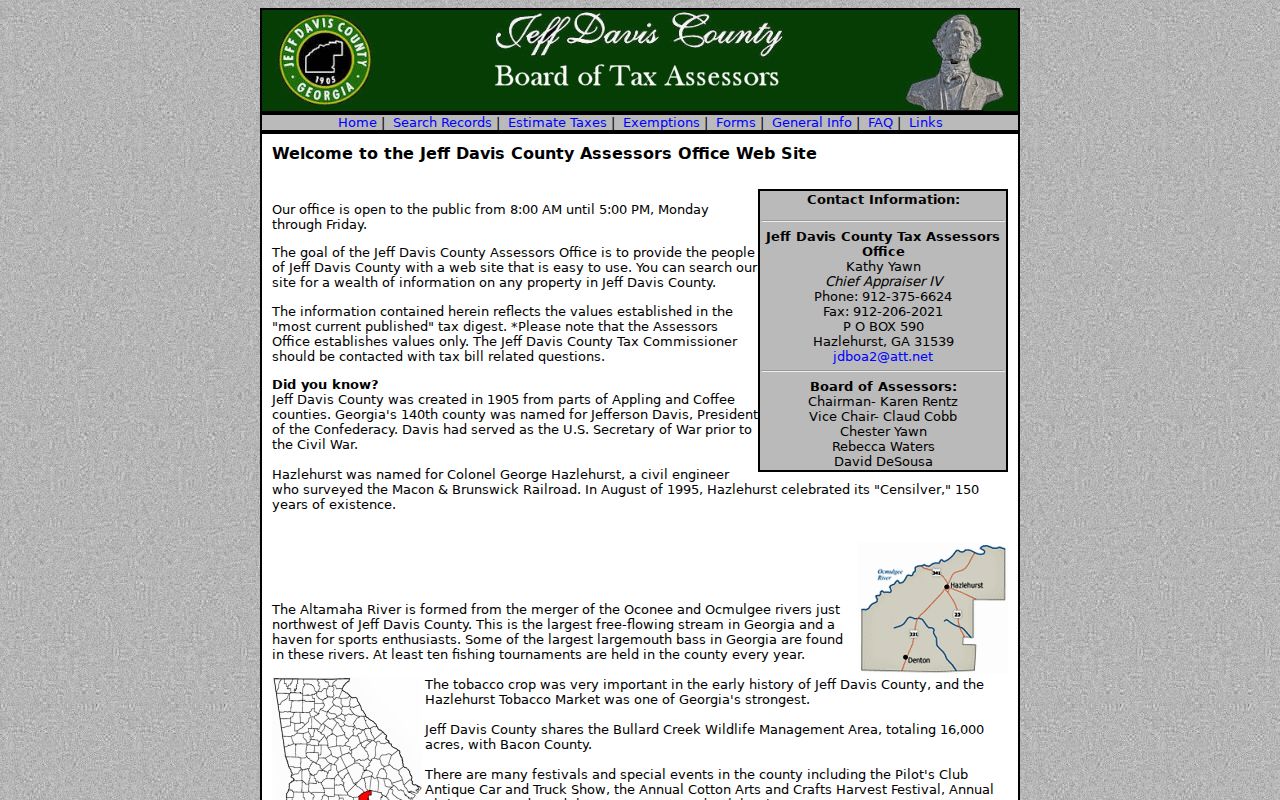
A landing page alone shows no parcel-level value fields. Those numbers come from a live parcel card. They can also come from a direct answer from the assessor's office. County Administration accepts a precise open-records request online, by email, by mail, or by hand delivery. It carries a stated three-business-day response period. Ask for existing multi-year value fields or a digest export. Staff can retrieve records; do not ask them to calculate a custom estimate. Note: a blocked vendor card is an access gap, not evidence that Jeff Davis County skipped valuing the parcel.
Apply Georgia's 40 Percent Rule
The Georgia Department of Revenue valuation guidance lays out the general 40 percent assessment ratio. When a card shows fair market value, multiply by that ratio. That should account for the assessed figure before exemptions. Special-use rules and the actual county record can still bend the math. Assessed value is not the tax bill. It is not the sale price either. The Tax Commissioner sets the levy and handles billing and collection. The assessors determine values. Exemptions can cut taxable value without touching the underlying fair market estimate at all.
Read Jeff Davis Sale Prices Carefully
The GSCCCA deed index can track down the latest warranty deed. It also covers quitclaims, gifts, estate deeds, foreclosures, sheriff's deeds, and tax-sale deeds. The transfer type matters enormously. Gifts, family transfers, partial interests, estate distributions, foreclosure deeds, and tax deeds make poor comparisons. Never use those figures for market value. Before using any consideration figure, match the deed's legal description to the assessment parcel. A parent tract, an exception, a parcel split, or an assemblage can distort the price. So can a multi-parcel transfer. Any of these can make the number useless for a single-parcel estimate.
Split Jeff Davis Land and Buildings
A solid property value record keeps land separate from improvements. In Jeff Davis County, timber, agriculture, rail corridors, and large tracts make that split matter. Two parcels with near-identical acreage can carry very different improvement components, access, or use classifications. The parcel card's exact labels vary, so copy them as displayed. Pull a live card. Record the land value, improvement value, and total fair market or appraised figure. Also record the assessed value, exemption, taxable value, prior-year figures, and tax district exactly. Keep each field distinct. Never collapse them into one number.
Compare Jeff Davis Places Fairly
The county publishes no official city-level historical value trend series for Hazlehurst or Denton. Any claim that one city's property values climbed by a stated rate would be unsupported. Build your comparison from parcel-level records instead. Use the same digest year and similar property types. Postal geography can mislead you here. ZIP codes 31539 and 31532 are handy search clues. But a mailing city says nothing about municipal boundaries. Before drawing any value inference, weigh situs, tax district, map location, acreage, use, building characteristics, and year.
Date Every Jeff Davis Value
qPublic describes its data as the most current published digest, not a live sale-price feed. A deed can record months before the assessor roll catches up. Note the digest year, your search date, the transfer date, and any prior-year value shown. Every number deserves a clear time frame. When a value shifts, request the existing assessment notice or multi-year roll fields. Do not guess at the cause. The tax-return and appeal materials may explain the procedural trail. A value inquiry should stop short of rebuilding the whole tax-bill or appeal process.
Limits of Jeff Davis Property Value
An assessment is a mass-appraisal number, not a verdict on what a house will fetch. It exists to feed the county tax roll, and nothing more. It cannot prove condition. It cannot settle a title question or pin down an exact boundary line. Even a freshly recorded sale price may hide terms or interests the index never shows. Treat it as one clue among many.
Value is not price. A Jeff Davis assessed value is for taxation and is not what the property would sell for. It is not an appraisal.
Before buying or selling, read the deed records yourself, walk the parcel, and bring in a qualified appraiser. Those steps beat any index. For the tax bill, an exemption, or an appeal, turn to the Tax Commissioner and the assessor records, each in its own channel.